

[For Medical Professionals, Researchers and Curious Minds.]
Introduction: How Tiny Creatures Reveal Big Truths in Forensic Entomology
When a human body begins to decompose, insects become the first and most reliable biological witnesses.
This field—known as forensic entomology—helps investigators determine timelines, toxins, and hidden crime-scene clues.
Related reading: Post-Mortem Interval Explained
In this simple yet authoritative overview, you’ll learn how insects act as “decomposition detectives” in medico-legal investigations.
1. What Is Forensic Entomology?
Forensic entomology is the scientific study of insects to help determine:
- Time since death (PMI)
- Whether a body was moved
- Presence of toxins or injuries
- Environmental conditions at the scene
It is one of the most accurate biological tools in modern forensic medicine.
2. Early Insect Arrival — The First Step in Decomposition Detection
Blowflies (Calliphoridae) reach a dead body within minutes.
Their early arrival provides the earliest possible estimate of the post-mortem interval (PMI).
Why it matters:
Early colonizers offer the first biological timestamp, even when medical clues are absent.
Also read: Forensic Science Basics You Should Know
3.The “Maggot Clock” – A Reliable Biological Timer
Maggots grow at a predictable developmental rate.
By examining their:
- Size
- Instar stage
- Growth pattern
forensic experts can estimate the time since death with high precision—a method known as the maggot development model.
This is one of the most powerful tools in forensic entomology.
4. Insect Succession Helps Reconstruct the Decomposition Timeline
Different insects arrive in a fixed succession pattern, such as:
- Blowflies
- Flesh flies
- Beetles
- Mites and wasps
This helps experts reconstruct the entire decomposition sequence, not just the beginning.
5. How Climate Influences Insect Evidence
Temperature, humidity, wind, and sunlight significantly alter:
- Insect arrival time
- Growth rate
- Colonization pattern
Understanding environmental impact makes PMI estimations more accurate.
6. Body Movement Clues Hidden in Insect Species
If insects found on a body do not match the environment, it suggests:
- The body was transported
- The original crime scene is different
- There was tampering
This provides strong medico-legal evidence in homicide investigations.
7. Toxin Detection Through Maggots (Entomotoxicology)
Maggots absorb:
- Drugs
- Poisons
- Chemicals
even after soft tissues have decomposed.
This field—entomotoxicology—helps reveal toxic agents when traditional samples are unavailable.
Why Insect Evidence Has Legal Significance
Because insect behavior is predictable and based on biological rules, it provides:
- Objective
- Reproducible
- Scientifically validated
evidence that strengthens medico-legal conclusions in court.
Conclusion: Nature’s Own Crime Scene Investigators
Insects may be tiny, but their scientific value in forensic investigations is enormous.
Through forensic entomology, experts can uncover:
- Hidden timelines
- Toxins
- Body movement
- Environmental influences
This makes insects the true “decomposition detectives” that reveal critical truths in medico-legal cases.
https://drhakimemedivault.com/forensic-entomology-insect-evidence/
Recommended reading: Entomotoxicology Explained
Explore More on:
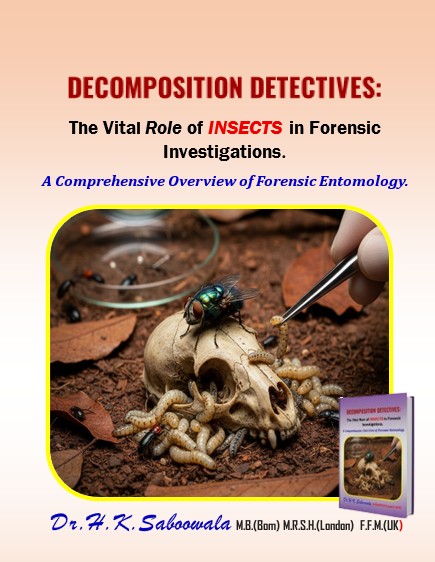
DECOMPOSITION DETECTIVES: The Vital Role of INSECTS in Forensic Investigations. A Comprehensive Overview of Forensic Entomology.by visiting my website: https://drhakimemedivault.com
OR
Scan “QR code” BELOW for “More Books “Link.

- https://drhakimemedivault.com/forensic-entomology-insect-evidence/
- Read Also: A Beginner’s Guide to Forensic Science & Medico-Legal Basics
- Anchor Text: Forensic Science & Medico-Legal Basics
- Centers for Disease Control and Prevention – Medical Examiner Resources
- National Library of Medicine – Forensic Entomology Overview
Medical Review
“Decomposition Detectives: The Vital Role of Insects in Forensic Investigations” offers a clear and accurate introduction to forensic entomology. The content is scientifically sound yet simplified for medicos, students, and curious readers.
This compilation is educational, well-organized, and useful for anyone seeking a quick, reliable overview of how insects assist in medico-legal investigations.
By Dr. R. K. Menon, M.D., D.F.M.
Consultant, Forensic Medicine
Thank You Note:
Thank you for reading this brief overview of forensic entomology. Your interest encourages the continued creation of simple, accessible medical and scientific content for learners and curious minds alike.
Dr. H. k. Saboowala. M.B.(Bom)M.R.S.H.(London)F.F.M.(UK)
Reader Note:
This article is part of an educational series that simplifies complex medico-legal and scientific topics. Readers are encouraged to explore related topics through internal links to gain broader understanding.
Disclaimer:
This content is intended solely for educational and informational purposes. It does not substitute professional medical, legal, or forensic advice. All interpretations are simplified for general understanding. Readers should consult qualified specialists for expert analysis or case-specific guidance.