By Dr. H. K. Saboowala
Introduction
Artificial intelligence in medical imaging is rapidly transforming modern healthcare by improving diagnostic accuracy, enhancing workflow efficiency, and enabling earlier detection of diseases. As imaging modalities such as X-rays, computed tomography (CT), and magnetic resonance imaging (MRI) generate increasingly complex and high-volume data, clinicians face growing challenges in timely and precise interpretation.
Medical imaging lies at the core of modern diagnostics, allowing visualization of pathological processes across organ systems. However, variability in human interpretation, increasing workload, and subtle imaging findings can impact diagnostic consistency. In this context, AI in medical imaging has emerged as a powerful solution, leveraging advanced computational algorithms to assist clinicians in making faster, more accurate, and data-driven decisions.
What is Artificial Intelligence in Medical Imaging?
Artificial intelligence in medical imaging refers to the application of computational algorithms that can analyze, interpret, and learn from imaging data. These systems are designed to mimic human cognitive functions while exceeding human capacity in pattern recognition.
Key technologies include:
- Machine Learning (ML): Identifies patterns and learns from structured datasets
- Deep Learning (DL): Utilizes multi-layered neural networks for complex data interpretation
- Convolutional Neural Networks (CNNs): Specialized models for image recognition and feature extraction
These approaches enable AI-based imaging tools to detect subtle abnormalities, quantify disease burden, and assist in clinical decision-making with high precision.
Role of AI in Radiology
Artificial intelligence is revolutionizing radiology by enhancing image interpretation and reducing diagnostic variability. AI in medical imaging enables automated detection of abnormalities across X-rays, CT scans, and MRI studies, supporting radiologists in making accurate and timely diagnoses.
Modern AI-based imaging tools utilize deep learning algorithms trained on large datasets to identify patterns that may not be visible to the human eye. This has significantly improved reporting efficiency and reduced turnaround time in high-volume clinical environments.
Additionally, AI in radiology plays a crucial role in prioritizing urgent cases, ensuring that critical findings such as intracranial hemorrhage or pulmonary embolism receive immediate attention.
Clinical Applications of AI
AI has demonstrated wide applicability across multiple medical specialties:
- Oncology: Tumor detection, segmentation, and treatment response monitoring
- Neurology: Early identification of stroke, Alzheimer’s disease, and neurodegenerative conditions
- Cardiology: Cardiovascular risk assessment and functional imaging analysis
These applications highlight the growing role of artificial intelligence in diagnostics in improving patient care and clinical outcomes.
For broader insights into digital health and artificial intelligence, refer to the World Health Organization (WHO) overview on digital health: https://www.who.int/health-topics/digital-health
Detailed applications of AI in radiology are available from the Radiological Society of North America (RSNA): https://www.rsna.org/
For cancer imaging and AI-based detection strategies, visit the National Cancer Institute: https://www.cancer.gov/
AI in Early Cancer Detection
One of the most significant contributions of AI in medical imaging is its role in early cancer detection. Early identification of malignancies is critical for improving survival rates and treatment success.
AI is increasingly used in:
- Mammography: Detection of early-stage breast cancer
- Low-dose CT scans: Screening for lung cancer
- MRI: Identification of brain tumors and soft tissue abnormalities
By reducing false positives and false negatives, AI-based imaging tools enhance diagnostic confidence and support timely clinical intervention.
Benefits and Limitations
The integration of AI in medical imaging offers multiple advantages:
- Improved diagnostic accuracy
- Reduced inter-observer variability
- Faster image analysis and reporting
- Enhanced predictive and prognostic capabilities
However, several challenges remain:
- Dependence on high-quality and diverse datasets
- Potential bias in algorithm training
- Regulatory and ethical considerations
- Need for large-scale clinical validation
Addressing these limitations is essential for safe and effective clinical implementation of artificial intelligence in diagnostics.
Integration with Modern Diagnostic Approaches
AI is increasingly integrated with advanced diagnostic technologies, creating a comprehensive and multimodal approach to disease detection. These include:
- Liquid biopsy for non-invasive cancer detection
- Molecular biomarkers for early disease identification
- Advanced screening and imaging technologies
The convergence of these modalities with AI in medical imaging is driving the evolution of precision medicine and personalized healthcare.
Table: Applications of AI in Medical Imaging
| Domain | Application | Clinical Benefit |
|---|---|---|
| Oncology | Tumor detection | Early diagnosis |
| Neurology | Stroke detection | Rapid intervention |
| Cardiology | Imaging analysis | Risk prediction |
Figure 1. AI Workflow in Medical Imaging
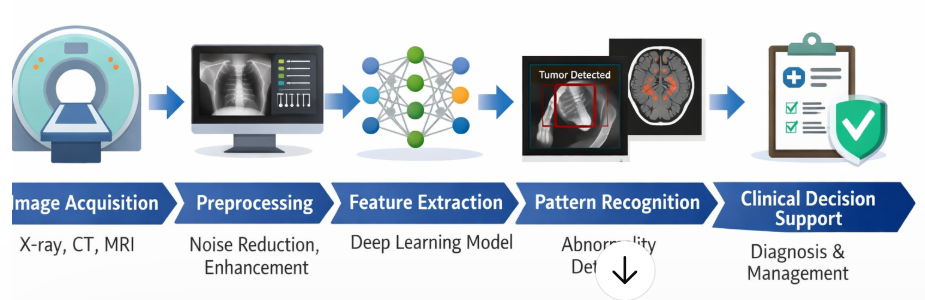
AI workflow in medical imaging typically involves image acquisition, preprocessing, feature extraction using deep learning models, pattern recognition, and clinical decision support output for diagnosis and management.
Future of AI in Medical Imaging
The future of AI in medical imaging is highly promising, with ongoing advancements in machine learning, data integration, and computational power. Emerging systems aim to combine imaging data with genomics, pathology, and electronic health records to provide comprehensive diagnostic insights.
Next-generation AI-based imaging tools are expected to offer real-time decision support, predictive analytics, and automated reporting, significantly enhancing precision medicine.
Importantly, AI in radiology is designed to augment, not replace, clinical expertise, enabling healthcare professionals to focus on complex decision-making.
Conclusion
Artificial intelligence in medical imaging is redefining modern diagnostics by improving accuracy, efficiency, and early disease detection. As these technologies continue to evolve, their integration into routine clinical practice will play a pivotal role in advancing patient care and improving clinical outcomes worldwide.
Related Reading
- Artificial Intelligence in Healthcare Applications
- Liquid Biopsy in Oncology: Non-Invasive Cancer Detection
- Molecular Biomarkers in Early Cancer Detection (coming next)
- Download Full Academic PDF: AI in Medical Imaging (coming soon)
External References
- World Health Organization (WHO) – Digital Health and AI
- Radiological Society of North America (RSNA)
- National Cancer Institute – AI in Cancer Imaging
Medical Review Note
This article is intended for educational and informational purposes and reflects current developments in artificial intelligence in medical imaging. Clinical decisions should be based on professional medical judgment and individual patient evaluation.
Medical Review
Medically reviewed and authored by Dr. Hakim Saboowala, MBBS
Independent Medical Scholar | Member, Indian Medical Association (IMA), New Delhi
Acknowledgment
Thank you for reading. This article is part of an ongoing initiative to translate complex medical innovations into structured, accessible, and academically relevant knowledge.
Disclaimer
The information provided in this article is for educational purposes only and does not constitute medical advice, diagnosis, or treatment. Readers are advised to consult qualified healthcare professionals for clinical concerns.