For Medical Professionals, Researchers and Curious Minds.
IIn the harsh vacuum of outer space—where radiation, freezing temperatures, and microgravity collide—space bacteria continue to shock scientists. Instead of dying, these microbes adapt, evolve, and sometimes become even stronger.
Recent experiments on spacecraft and the International Space Station (ISS) show that these organisms are rewriting our understanding of biology, evolution, and the boundaries of life.
What Are Space Bacteria?
Space bacteria are Earth-origin microbes that manage to survive and thrive in extreme space environments. When exposed to cosmic rays, vacuum conditions, and zero gravity, they undergo remarkable biological changes.
Exposed to intense cosmic conditions, they often:
1. Rapid Mutation Under Space Radiation
High-energy radiation triggers accelerated genetic changes in space bacteria. These mutations can increase survival fitness far beyond what is seen on Earth.
Cosmic radiation accelerates the mutation rate of space bacteria.
These mutations may create new survival pathways, alter DNA repair mechanisms, and increase evolutionary fitness far more rapidly than on Earth.
Scientists study these changes to understand long-term microbial evolution in extraterrestrial environments.
2. Stronger Biofilm Formation in Microgravity
In zero gravity, bacteria form thicker, tougher biofilms. This makes them harder to eliminate and more resistant to stress.
3. Increased Antibiotic Resistance
Studies show that space bacteria often develop resistance to antibiotics faster, posing potential risks for long-duration missions.
4. Enhanced Growth and Virulence
Many microbial species grow more aggressively in microgravity, which may increase infection risk for astronauts.
5. Ability to Withstand Extreme Temperature Swings
Some bacteria survive freezing, thawing, and re-freezing cycles during orbital missions—conditions fatal to most organisms.
6. Clues to Possible Extraterrestrial Life
If Earth microbes can tolerate space, it strengthens the possibility that life might exist on Mars, Europa, or Titan.
7. Implications for Medical Biotechnology
Space-induced stress responses help scientists design new strategies for:
- Drug resistance research
- Vaccine development
- Industrial bioproduction
Why They Matter
1. Astronaut Health & Mission Safety
More virulent bacteria may increase infection risk during long missions.
2. Planetary Protection
We must prevent Earth microbes from contaminating Mars—and vice versa.
3. Understanding the Limits of Life
Space bacteria demonstrate that life is far more resilient than previously believed.
4. Medical & Scientific Innovation
Space research accelerates discoveries in genetics, immunity, and biotechnology.
Final Thought
“Space bacteria teach us that life is not just adaptable—it’s unstoppable.”
— Dr. H.K. Saboowala
Download the full eBook to explore microbial mysteries in space
Tags:space bacteria, astrobiology, gene mutation, ISS microbes, planetary
Now Available at: https://drhakimemedivault.com
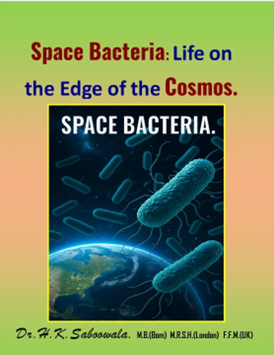
Space Bacteria: Life on the Edge of the Cosmos.

“QR code”
For purchasing the TITLE and “More Books “Linking to full CATALOGUE.
Related Reading.
Readers interested in deeper scientific and medical perspectives on space microbiology may explore the following related publications and research themes published by Dr. Hakim:
• Survival Mechanisms of Bacteria in Space Environments
• Microbial Adaptation Beyond Earth
• Spaceflight, Microgravity, and Human Health
• Astrobiology and Extremophile Microorganisms
Further Reading
For readers interested in institutional research on microbial survival in space environments, NASA’s Astrobiology Program provides ongoing insights into microbial adaptability under cosmic radiation and microgravity conditions.
Medical Review
“An insightful and timely overview of how bacteria adapt and evolve in space. This work bridges microbiology and space medicine with clinical clarity — a valuable resource for researchers and health professionals alike.”
Dr. Nikhil R. Sharma, MD (Microbiology)
Institute of Space Health & Medical Research.
Thank You Note
Thank you to all our esteemed readers and medical professionals for your continuous support.
Your feedback inspires us to publish more valuable and cutting-edge content.
Dr. H.K. Saboowala, M.B.(Bom), M.R.S.H.(London), F.F.M.(UK)
Disclaimer:
This Content is for informational and educational purposes only. It does not replace professional medical or scientific advice. Readers should consult qualified experts or verified research sources for specific guidance.