

[For medical professionals, health-science learners, and informed readers interested in evidence-based medicine]
Scholarly Identification
Scholarly synthesis underpinning this work is archived in a public research repository (Zenodo), linked to the author’s persistent ORCID record, and indexed within OpenAIRE, supporting formal attribution, discoverability, and long-term accessibility across academic indexing systems.
Scholarly Profiles:
DOI: https://doi.org/10.5281/zenodo.18708554
Orcid iD:https://orcid.org/0009-0005-3523-774X
Introduction.
The connection between neuroplasticity and brain aging has revolutionized neuroscience.
Once thought to decline irreversibly with age, the human brain is now known to remain active, flexible, and self-repairing throughout life.
This informative overview explores five scientific breakthroughs revealing how neuroplasticity and brain aging work together to preserve memory, intelligence, and emotional balance across the decades.
Related reading:
Cellular Aging and Senolytics – Read more here.
1. Neuroplasticity and Brain Aging Remain Adaptable
Beyond Midlife
Modern imaging studies have proven that neuroplasticity and brain aging continue forming new synapses, even into the 80s and 90s.
This means that every new skill, whether learning digital tools, painting, or solving puzzles, creates alternative neural pathways that compensate for age-related loss.
Such adaptive rewiring strengthens resilience, proving that the aging brain never truly stops evolving.
2. How Neuroplasticity and Brain Aging Affect Cognitive Health
Lifestyle and environment have a measurable influence on neuroplasticity and brain aging.
Social engagement, lifelong learning, and physical activity stimulate the release of Brain-Derived Neurotrophic Factor (BDNF), a protein that nurtures neuronal growth.
Conversely, stress and isolation reduce BDNF, accelerating cognitive decline.
This discovery underscores that experience isn’t just enriching—it’s biologically transformative for brain plasticity.
3. Neuroplasticity and Brain Aging : The Molecular Choreography That Sustains Cognitive Function
At the cellular level, neuroplasticity and brain aging rely on delicate molecular synchronization.
Balanced cholesterol metabolism, neurotransmitter dynamics, and calcium signalling maintain neural communication efficiency.
Disturbances in these pathways are now linked to early cognitive dysfunction.
Emerging research shows that cholesterol, a molecule often misunderstood, plays a central role in maintaining membrane integrity and facilitating synaptic renewal.
4. Neuroplasticity and Aging Brain: Lifestyle Habits That Strengthen Lifelong Brain Adaptation
Daily routines profoundly shape neuroplasticity and aging brain.
Key evidence-based strategies include:
- Continuous Learning:
- Stimulates cortical regeneration and neural adaptability.
- Aerobic Exercise:
- Enhances hippocampal growth and vascular health.
- Mindfulness Practice:
- Improves attention and emotional control.
- Neuro-Nutrition:
- Diets rich in protect neuronal membranes.
- Social Interaction:
- Strengthens multi-region neural circuits and protects against dementia.
Regular adherence to these habits amplifies neuroplastic efficiency and extends cognitive youthfulness.
5. 5 Key Neuroplasticity Discoveries Transforming the Aging Brain
The ultimate revelation of modern neuroscience is that neuroplasticity and aging brain are partners in lifelong renewal.
Each novel experience or thought reshapes neural circuits, building what experts call cognitive reserve.
- This reserve delays the onset of age-related memory disorders and reinforces emotional stability.
In short, maintaining a flexible mind ensures a flexible life, the essence of cognitive longevity.
Conclusion:Harnessing Neuroplasticity for Lifelong Cognitive Health
The interplay between neuroplasticity and aging brain is no longer a theoretical idea but a proven biological truth.
The human brain retains remarkable adaptability, capable of learning, recovery, and creative growth at any stage of life.
By embracing:
- Intellectually active lifestyles,
- Balanced nutrition, and
- Emotional engagement, individuals can sustain mental sharpness for decades.
Related Reading
• Lifelong Neuroplasticity and Cognitive Resilience
• Brain Aging and Memory Preservation
• Neurogenesis and Synaptic Remodeling in Adults
• Lifestyle, Nutrition, and Brain Health Across Aging
Further Reading
National Institute on Aging (NIA) — Brain Plasticity and Aging
https://www.nia.nih.gov/health/brain-health
Want to dive deeper?
Explore the full illustrated eBook:
Front cover with caption below.
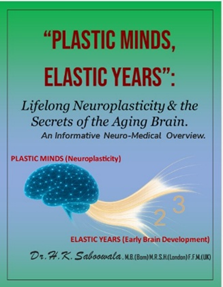
“PLASTIC MINDS, ELASTIC YEARS”: Lifelong Neuroplasticity and the Secrets of the Aging Brain.
An Informative Neuro-Medical Overview.
By Dr. H. K. Saboowala, M.B.(Bom), M.R.S.H.(London), F.F.M.(UK)
How to Get a Book:
Visit: https://drhakimemedivault.com
OR
Scan “QR code” below to buy and explore over 350+ high-value medical titles.

Medical Review:
“This review captures current consensus that neuroplasticity extends throughout lifespan, integrating molecular, behavioural, and clinical perspectives.”
Reviewed for scientific accuracy by Dr. A. Mehra, MD (Neuroscience, AIIMS New Delhi); Member, International Society for Cognitive Neuroscience.
Thank You Note:
Thank you for exploring this medical insight on neuroplasticity and the aging brain. Your continued curiosity fuels the mission of making complex neuroscience both accurate and accessible to healthcare professionals and lifelong learners.
Reader Note:
If you found this useful, consider subscribing for upcoming posts on molecular neuroscience, cognitive health, and preventive geriatrics.
Disclaimer
This article is intended for educational and informational purposes only. It does not constitute medical advice or replace professional consultation.
Readers should seek individualized guidance from qualified healthcare professionals before applying any discussed concepts to personal health or patient care.