
Dr. Hakim Saboowala. M.B.(Bom) M.R.S.H.(London) F.F.M.(UK)
Introduction
Molecular autopsy in sudden cardiac death investigation has become an increasingly important advancement in modern forensic medicine and forensic genomics. Conventional autopsy remains the foundation of forensic death investigation and continues to play a central role in determining the cause of death in medico-legal practice. However, despite major advances in forensic pathology, there are still cases of sudden and unexplained death in which routine post-mortem examination fails to identify a definitive anatomical cause. These unresolved cases, often referred to as “negative autopsies,” represent one of the most important challenges in modern forensic medicine.
In many instances, sudden unexplained death may result from inherited cardiac disorders that do not produce visible structural abnormalities within the heart. Conditions such as long QT syndrome, Brugada syndrome, catecholaminergic polymorphic ventricular tachycardia, and certain inherited cardiomyopathies may cause fatal arrhythmias despite structurally normal findings at conventional autopsy.
Molecular autopsy in sudden cardiac death cases addresses this diagnostic limitation through post-mortem genetic analysis aimed at identifying inherited pathogenic variants associated with fatal arrhythmogenic disorders. By integrating forensic pathology with molecular genetics and genomic sequencing, molecular autopsy extends forensic investigation beyond visible anatomical findings and strengthens the role of precision forensic medicine in unexplained sudden death investigation.
Molecular autopsy in sudden cardiac death investigation has emerged as an important advancement that addresses this diagnostic limitation through post-mortem genetic analysis.
By integrating forensic pathology with molecular genetics and genomic sequencing, molecular autopsy enables the detection of inherited genetic abnormalities associated with sudden cardiac death and unexplained fatal arrhythmias.
The significance of molecular autopsy extends beyond forensic diagnosis alone. Identification of pathogenic genetic variants may additionally provide important clinical information for surviving biological relatives who could carry similar inherited abnormalities. Through family screening, genetic counseling, preventive cardiovascular evaluation, and early clinical intervention, molecular autopsy strengthens the connection between forensic medicine and preventive healthcare.
The Problem of the Negative Autopsy in Sudden Cardiac Death
The concept of the negative autopsy has become increasingly important within forensic pathology because a proportion of sudden deaths remain unexplained even after complete medico-legal examination.
These cases are particularly significant among:
- young individuals,
- athletes,
- and persons with sudden collapse without prior clinical diagnosis.
In such situations, inherited electrical cardiac disorders may be responsible despite the absence of visible structural abnormalities within the myocardium.
Molecular autopsy in sudden cardiac death cases therefore provides an additional investigative pathway capable of identifying molecular and genetic causes of death that cannot be detected through routine pathological examination alone.
How Molecular Autopsy Helps Identify Hidden Causes of Death
Molecular autopsy involves post-mortem genetic analysis aimed at identifying inherited abnormalities associated with sudden unexplained death.
Advances in genomic sequencing technologies have significantly improved the ability to detect pathogenic variants linked to inherited arrhythmogenic disorders and sudden cardiac death syndromes.
This genomic approach extends forensic investigation beyond visible anatomical findings and strengthens the role of molecular autopsy in sudden cardiac death investigation within modern forensic medicine.
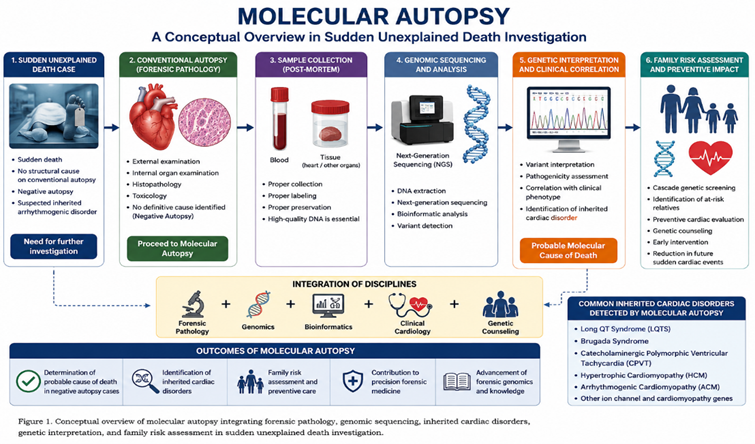
Figure 1.Conceptual overview of molecular autopsy integrating forensic pathology, genomic sequencing, inherited cardiac disorders, genetic interpretation, and family risk assessment in sudden unexplained death investigation
Genetic Mechanisms Underlying Sudden Death
Inherited cardiac disorders associated with sudden unexplained death commonly involve abnormalities affecting:
- ion channel function,
- cardiac electrical conduction,
- sarcomeric proteins,
- and myocardial structural integrity.
These molecular abnormalities may predispose affected individuals to lethal ventricular arrhythmias without producing gross structural pathology detectable at conventional autopsy.
As forensic genomics continues to evolve, molecular autopsy has become increasingly valuable for identifying the molecular basis of unexplained sudden cardiac death and inherited arrhythmogenic syndromes.
Clinical and Preventive Implications
One of the most important aspects of molecular autopsy is its preventive and familial significance. Identification of inherited pathogenic variants may allow:
- screening of biological relatives,
- individualized cardiovascular risk assessment,
- genetic counseling,
- preventive monitoring,
- and early medical intervention.
Thus, molecular autopsy not only contributes to forensic clarification of death but also supports preventive medicine and reduction of future sudden cardiac events among at-risk family members.
Table 1. Major inherited disorders commonly investigated through molecular autopsy.
| Disorder | Molecular Basis | Forensic Relevance |
| Long QT syndrome | Ion channel mutations | Sudden arrhythmic death |
| Brugada syndrome | Sodium channel dysfunction | Negative autopsy cases |
| Hypertrophic cardiomyopathy | Sarcomeric mutations | Sudden cardiac death |
| Arrhythmogenic cardiomyopathy | Desmosomal abnormalities | Ventricular arrhythmias |
Limitations and Practical Challenges
Despite its growing significance, molecular autopsy faces several practical and interpretive challenges, including:
- variants of uncertain significance,
- incomplete genotype-phenotype correlation,
- ethical considerations,
- limited access to genomic testing facilities,
- and lack of universal standardization.
Interpretation of molecular findings additionally requires multidisciplinary collaboration involving forensic pathologists, geneticists, cardiologists, and genomic specialists.
Future Directions in Molecular Autopsy
Future developments in molecular autopsy are expected to involve:
- artificial intelligence-assisted genomic interpretation,
- computational forensic genomics,
- expanded genomic databases,
- precision forensic medicine frameworks,
- and improved variant classification systems.
The integration of genomics, artificial intelligence, and computational medicine may significantly enhance the future diagnostic accuracy and
Conclusion
Molecular autopsy in sudden cardiac death investigation represents an important advancement in forensic genomics and modern forensic medicine. By integrating genomic analysis into post-mortem investigation, molecular autopsy extends forensic evaluation beyond conventional anatomical examination toward molecular-level identification of inherited cardiac disorders.
As forensic genomics and precision medicine continue to evolve, molecular autopsy is expected to play an increasingly important role in sudden unexplained death investigation, preventive cardiology, and family risk assessment.
Independent Medical Scholar
Scholarly Profiles:
DOI: https://doi.org/10.5281/zenodo.18708554
ORCID: https://orcid.org/0009-0005-3523-774X
Related Reading
- Genetic Sudden Cardiac Death: A Comprehensive Molecular Autopsy Guide for Forensic and Clinical Practice
- AI in Molecular Autopsy: Transforming Forensic Investigation of Sudden Death
Further Reading
Access the Full Academic Book / Monograph
Visit: https://drhakimemedivault.com
Related Academic Topics by the Author
- Molecular Autopsy
- Forensic Genomics
- Sudden Cardiac Death
- Precision Forensic Medicine
- Artificial Intelligence in Forensic Medicine
Download Full Academic PDF