

Introduction
The study of genetic disorder pathogenesis offers a unique window into human development. Rare congenital conditions—though uncommon—highlight how precise and tightly regulated embryonic processes must be for normal growth.
When these processes are disrupted, the result can be striking anatomical and functional abnormalities.
Developmental Errors in Genetic Disorder Pathogenesis
Most rare genetic anomalies arise during early embryogenesis. At this stage, even minor disruptions in gene expression or cellular signaling can lead to major structural defects.
Key contributing factors include:
- Genetic mutations
- Errors in developmental signaling pathways
- Abnormal tissue differentiation
Craniofacial and Neural Defects in Genetic Disorder Pathogenesis
Conditions such as Cyclopia and Anencephaly illustrate severe disruptions in early developmental patterning.
Diagrammatic representation of how disruptions in embryonic development lead to A.Ccraniofacial anomalies, B. Neural tube defects, and C. Limb malformations.
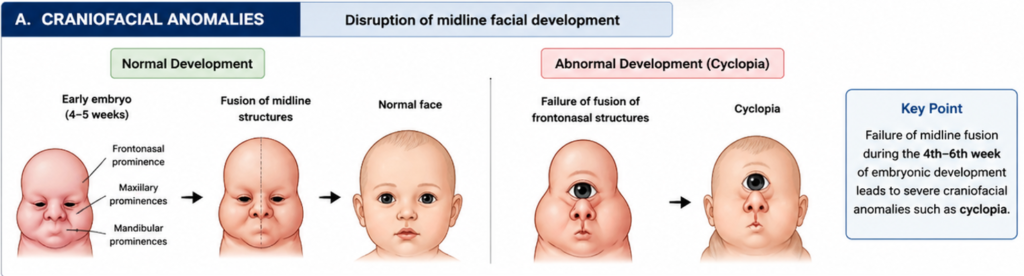
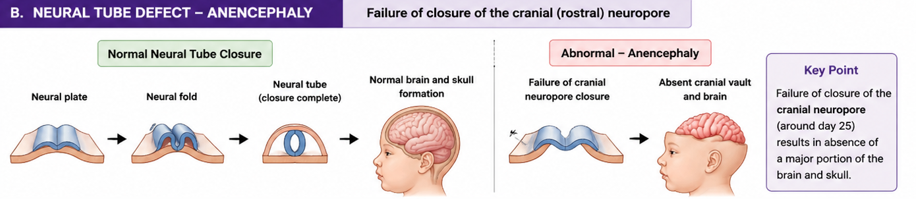
These disorders reflect failures in:
- Midline formation
- Neural tube closure
- Brain development
Abnormal Growth and Tissue Regulation in Genetic Disorder Pathogenesis
Neurofibromatosis and Proteus syndrome demonstrate how dysregulated cellular growth contributes to genetic disorder pathogenesis.
Such conditions provide insight into:
- Tumor biology
- Cellular proliferation pathways
- Genetic mosaicism
Limb and Structural Anomalies
Disorders like Polymelia and Ectrodactyly arise from disruptions in limb development.
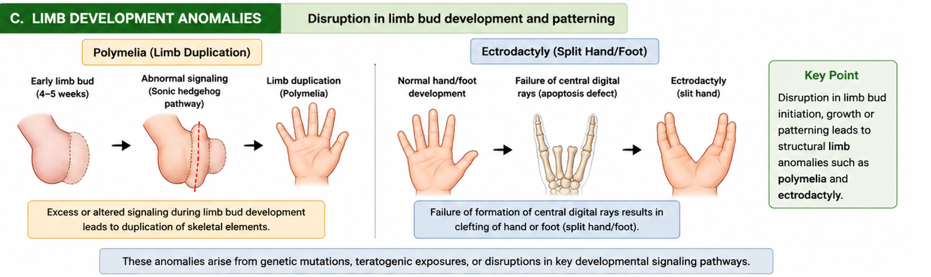
These highlight:
- Errors in limb bud formation
- Abnormal gene expression gradients
Skin and Barrier Disorders
Harlequin ichthyosis represents a severe defect in skin barrier formation, emphasizing the importance of structural protein function in development.
Why These Disorders Matter
Although rare, these conditions are not just clinical curiosities. They help researchers understand:
- Fundamental mechanisms of human development
- Gene–environment interactions
- Targets for future therapies
Conclusion
Genetic disorder pathogenesis reflects the complexity of human development. These rare conditions demonstrate how tightly coordinated biological processes must be—and how even small disruptions can have profound consequences.
Studying them continues to advance both clinical medicine and developmental biology.
Core Insights
- Genetic disorder pathogenesis arises from early developmental disruption
- Rare anomalies reveal key biological mechanisms
- Growth, neural, and structural pathways are commonly affected
- These conditions guide future research and clinical innovation
Related Reading
https://drhakimemedivault.com/genetic-disorder-pathogenesis/
Further Resources
World Health Organization (WHO)”
Explore the complete work
Access the Full Book WEBSITE
Further Reading
Understanding congenital and developmental disorders is supported by public health research from the Centers for Disease Control and Prevention.
Author Note
Dr. H. K. Saboowala, M.B.(Bom), M.R.S.H.(London), is an independent medical scholar focused on developmental biology and molecular medicine.
Download Full Academic PDF: